
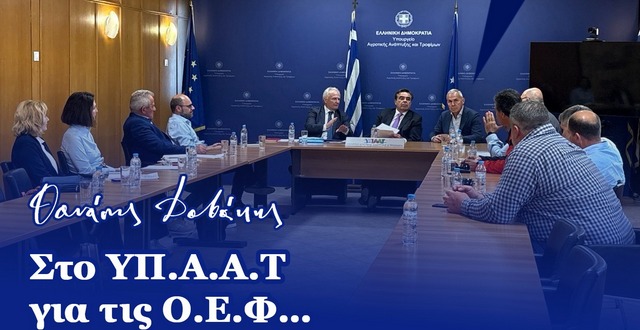
On a significant day for the agricultural community of Laconia, Deputy Minister of National Defense and local MP, Thanasis Davakis, participated in a comprehensive meeting held at the Ministry of Rural Development and Food on May 13, 2026. Charged by Minister Margaritis Schoinas and Deputy Minister Giannis Andrianos, the gathering aimed to address the progress of the Operational Programs of the Olive Oil Producer Organizations (O.E.F.).
The meeting saw the attendance of key representatives from various cooperatives in Laconia, including:
– Nikos Grammatikakis from KASELL A.E.S, representing eight member cooperatives,
– Sotiris Kritikos from the Agricultural Cooperative of Agios Dimitrios,
– Tasos Sargkanis from the Agricultural Cooperative of Sikias,
– Giannis Laggis representing the Agricultural Cooperative of Metamorfosis,
– Vasilis Spiridakos from the Agricultural Cooperative of Papadianika, and
– Christos Terziotis from the Agricultural Cooperative of Asopos.
Following the gathering, Davakis emphasized that this meeting was a continuation of previous discussions held in March with Deputy Minister Giannis Andrianos. Minister Margaritis Schoinas assured the cooperative representatives that there is a political commitment to resolve the challenges faced in implementing the Operational Programs of O.E.F.
Deputy Minister Giannis Andrianos outlined the initiatives taken to overcome current barriers and shared the ministry’s proposed solutions. Notably, he disclosed that on April 16, 2026, he had written to the European Commission’s relevant General Directorate for Agriculture. His inquiry concerned a potential early cessation of the ongoing three-year operational programs of O.E.F. and the possibility of covering eligible expenses from 2024 and 2025 with national resources. Furthermore, he mentioned plans to re-launch an at least three-year O.E.F program within 2026, aimed for implementation from 2027 to 2029.
In turn, cooperative representatives voiced their concerns regarding the financial strain arising from the halted implementation of the Programs. They urged the political leadership to find solutions for 2026 as well, highlighting the financial gap that would exacerbate the challenges for cooperatives. The political leadership committed to reviewing this issue contingent on a positive response from the European Commission regarding the aforementioned inquiry.
Davakis pointed out the critical need for these programs to progress, advocating for the prompt payment of owed funds and a reassessment of the ministry’s proposed solution to include 2026. He stressed that failure to address these matters could significantly impact many healthy olive-producing cooperatives, ultimately affecting the local economy and the primary sector.
This meeting not only reflects the ongoing commitment of local authorities to support agricultural development but also underscores the urgency of addressing funding gaps and ensuring the viability of vital agricultural programs in the region.