

In the ongoing public discourse surrounding Greece’s energy transition, a significant yet often overlooked issue has emerged: the dependency on marginal natural gas units within the wholesale market. Despite the increasing integration of renewable energy sources, household energy bills remain vulnerable to international fuel price fluctuations. A pressing solution now advocated is the harnessing of geothermal energy—not merely as a supplementary source, but as a foundational element of the country’s energy mix.
Understanding the «Marginal Pricing Mechanism»
To grasp why electricity prices are what they are, one must examine the Energy Exchange and the Marginal Pricing Model (Target Model). In this framework, the price of electricity for each hour is determined not by the average of bids but by the last unit that «closes» the system to meet demand. Currently, during most hours, this marginal unit is natural gas. When demand peaks, the system resorts to activating expensive gas units, which inflates prices for all producers, including those generating electricity at zero cost, such as solar and wind.
Geothermal Energy as a Solution to Price Increases
The introduction of geothermal units utilizing Organic Rankine Cycle (ORC) technology presents a distinct advantage that solar energy lacks: stability (Base Load).
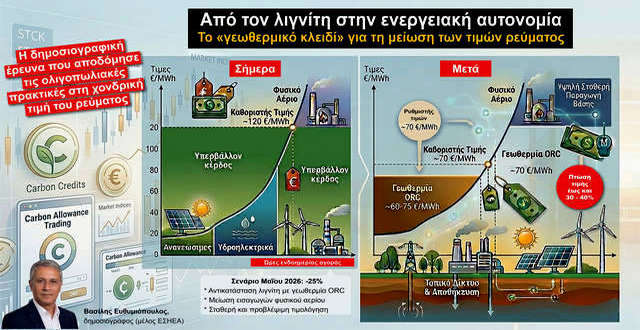
Displacing Natural Gas: With an installed capacity of 1,000 MW, geothermal energy could consistently provide 24,000 MWh daily. This capacity acts as a buffer; during periods of reduced sunlight and high demand, the system would not need to rely on costly natural gas.
Dramatic Price Reduction: With a Levelized Cost of Energy (LCOE) ranging from €50 to €75 per MWh, geothermal energy shifts the «supply curve» to the right. Practically, this means that expensive gas units (which demand €120 to €150 per MWh) would be sidelined, as the system would already be covered by the cheaper geothermal units.
A Forecast Based on May 2026 Data
Analyzing the market situation on May 31, 2026, where the average price was set at €87.36 per MWh, the implications of geothermal intervention are striking:
- Without Geothermal: Natural gas maintains dominance, dictating high clearing prices during peak hours.
- With 1,000 MW of Geothermal: The price ceiling collapses. It is estimated that the average daily wholesale price could have converged to €70 per MWh, yielding significant savings for Greek households and businesses.
Conclusion: The Path to Energy Independence
Geothermal energy is not merely a «green» choice; it represents a strategic move towards the economic fortification of the nation. By developing geothermal energy infrastructures, Greece can transform its energy vulnerabilities into strengths, creating a self-regulating system characterized by low costs and high reliability. The critical question moving forward is not whether the technology works—the numbers confirm its efficacy—but rather how swiftly the investment and political frameworks can support the transition to a truly independent and affordable energy market.