
In the days leading up to the fall of Constantinople, the Byzantine Empire existed only in name, reduced to a shadow of its former glory. Its territory was largely confined to the area surrounding the capital and a few scattered regions, such as the Despotate of Mistra. Internal strife, religious disputes, and the looming threat of the Ottomans had transformed what was once a formidable empire into a mere specter of its illustrious past.
As the Ottoman forces approached, the Byzantines found themselves in a precarious position, relying on the assistance of Catholic Europe, which was deeply resented by the inhabitants of Constantinople. The division between the «Unionists» and «Anti-Unionists» further complicated matters. In a desperate bid for support, Emperor Constantine Palaiologos sent an embassy to Pope Nicholas V, seeking aid. The Pope, however, insisted on the condition of Church Union, yet agreed to send priests to persuade the populace of its necessity.
The papal envoys, Cardinal Isidore and Archbishop Leonard of Mytilene, conducted services in Hagia Sophia, inciting public outrage. Crowds filled the streets, rallying around the anti-Unionist faction led by the future Patriarch Gennadios Scholarios. The prevailing sentiment was one of rejection: «We need neither the help of the Latins nor their union. Remove from us the worship of unleavened bread.»
This animosity towards the Latins stemmed not only from doctrinal differences but also from the collective memory of the brutality displayed by the Crusaders during the First Sack of Constantinople in 1204. Additionally, the economic encroachment of Venice and Genoa had pushed many inhabitants to the brink of destitution, further fueling resentment against Catholic powers.
In contrast, the Ottomans appeared to treat Christians with relative leniency. Many Christians held prominent positions within the Ottoman administration and military, and the rural population benefited from lower taxes and greater security. This led to a faction within Constantinople that viewed the Ottomans favorably, as expressed by Lukas Notaras, who famously stated, «It is better to see a Turkish cap in the middle of the city than a Latin hood.»
By early 1453, Sultan Mehmed II was preparing for the conquest of Constantinople, amassing an army of 150,000 men and a navy of 400 ships, equipped with the most advanced artillery of the time, including a massive cannon crafted by Saxon engineers. On April 7, the Sultan officially declared the siege of Constantinople from his camp near the Gate of St. Romanus.
The odds were heavily stacked against the Byzantines, who could muster only 7,000 defenders, including 2,000 mercenaries, primarily Venetians and Genoese. The city itself was home to around 50,000 residents, grappling with food shortages.
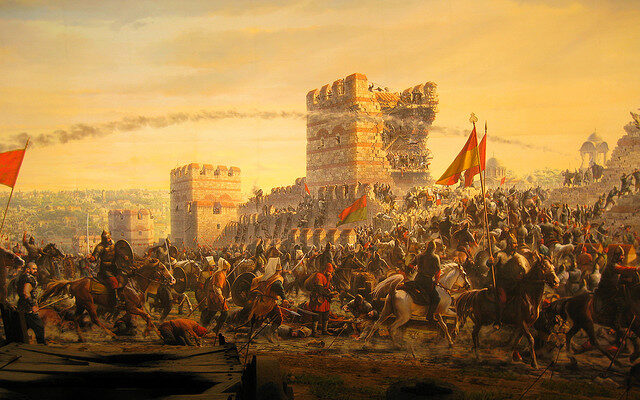
Constantinople was fortified by a double wall and a moat that had successfully repelled numerous attacks for a millennium. However, this once-impenetrable defense was now vulnerable to the Sultan’s artillery, which began bombarding the walls daily from April 12 onward.
The Ottomans made several attempts to breach the chain blocking the Golden Horn, which protected the eastern side of the city. On April 20, a small fleet led by Captain Fladanel successfully broke through the Turkish blockade, bringing much-needed supplies and momentarily lifting the spirits of the besieged.
Realizing that artillery alone would not suffice to capture the city while the Golden Horn remained secure, Mehmed employed an Italian engineer to construct a canal, allowing approximately 70 ships to be dragged from the Bosporus into the Golden Horn during the night of April 21-22. This maneuver left the defenders in a dire situation, forcing them to divert forces from the walls to protect the city from the newly vulnerable side.
The final assault by the Ottomans occurred on the morning of May 29, 1453. Thousands of Mehmed’s soldiers surged into the nearly defenseless city, capturing it within hours. Emperor Constantine Palaiologos, who had bravely rejected Mehmed’s offers of surrender, fell heroically in battle. After slaughtering the city’s defenders, the Ottoman forces engaged in widespread looting and enslavement. That evening, Mehmed the Conqueror triumphantly entered Hagia Sophia, praying to Allah «upon the Holy Table,» as chroniclers of the time recorded.
This pivotal moment in history marked the end of the Byzantine Empire and the rise of Ottoman dominance, reshaping the geopolitical landscape of the region for centuries to come.